Lung nodule detection
Research prototype, not a medical device. Labels are radiologist consensus, not biopsy.
- Scope
- Research prototype
- Dataset
- LIDC-IDRI
897 scans, 1,192 nodules - Architecture
- LoG blob detector + 3D CNN, 5-seed ensemble
- Evaluation
- CPM 0.823
95% CI 0.767–0.868 - Artifacts
predict.py
Gradio demo- Built with
- Claude (code)
Design, evaluation: mine
Problem
Find lung nodules in a full chest CT scan: the ones that at least 3 of 4 radiologists marked and that are 3 mm or larger. The system says nothing about cancer.
Data
- LIDC-IDRI: 1,010 patients and 1,018 CT scans, with up to 4 radiologists per scan.
- Slices of 2.5 mm or thinner; a nodule is ≥ 3 mm and marked by ≥ 3 of 4 readers. That gives 897 scans and 1,192 nodules.
- Split by patient, 70/15/15: train 628 scans, validation 134 scans (147 nodules), test 135 scans (225 nodules). The test set was opened once.
Method
- Fetch LIDC-IDRI scans and the radiologists’ marks.
- Isolate the lungs: Hounsfield units, 1 mm voxels, a lung mask.
- Nominate candidates with a Laplacian-of-Gaussian blob detector at 7 sizes (high recall, no training).
- Discard false candidates with a 3D CNN on 32 mm cubes, using HU, blobness and vesselness channels, as a 5-seed ensemble.
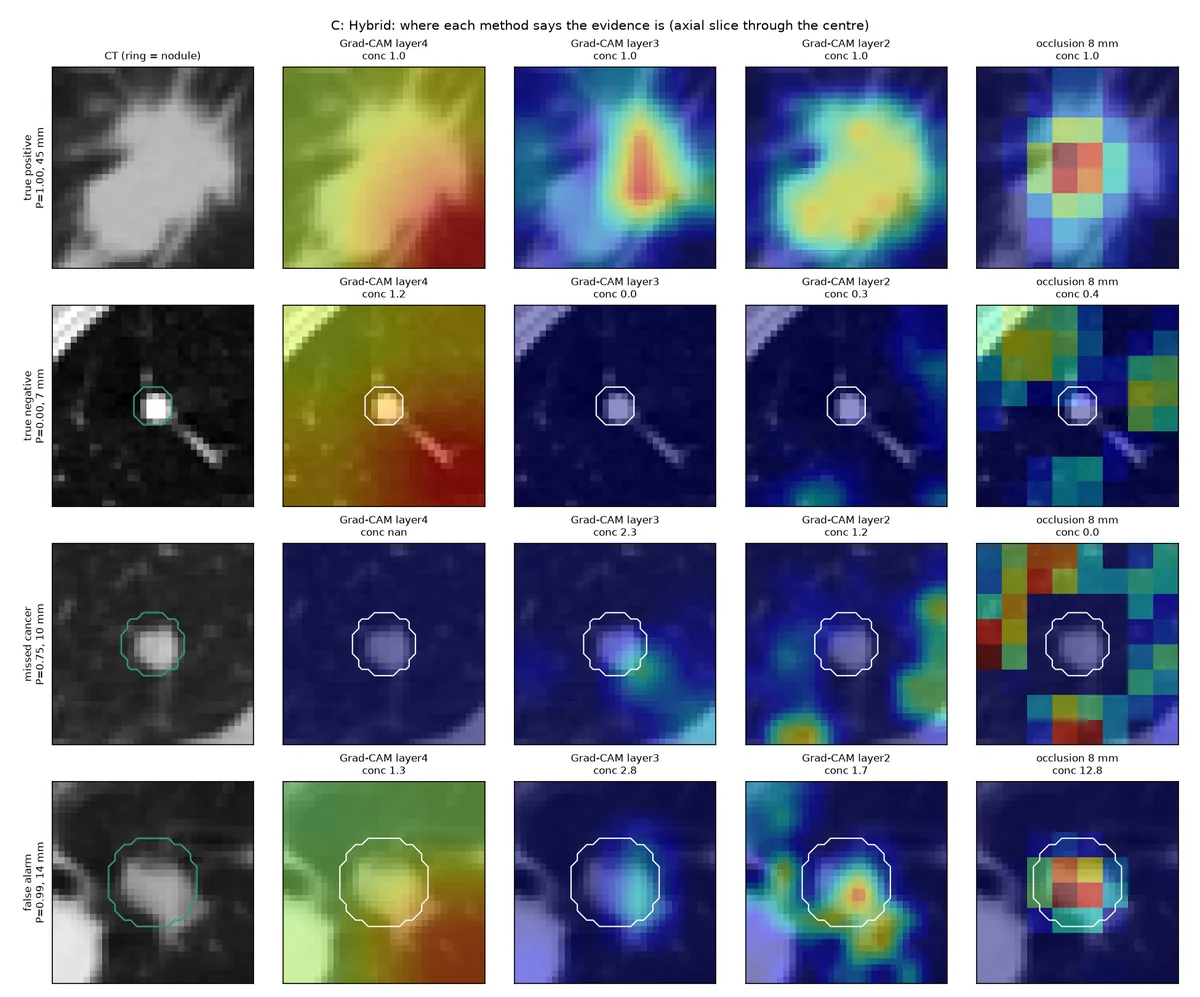
- Explain each finding with occlusion maps, checked against random weights.
- Rate with FROC, CPM and bootstrap confidence intervals.
- Ship as
predict.pyand a Gradio demo.
Each model change had to beat the one before it by more than the seed-to-seed spread. Bundling several tricks at once made results worse (0.717 vs 0.778 on validation), so changes were tested one at a time.
Results
| Model | CPM | 95% CI | Found at 1 false alarm / scan |
|---|---|---|---|
| No learning (blob strength only) | 0.058 | 0.031–0.094 | 5.3% |
| 3D CNN, 5 seeds | 0.797 | 0.725–0.847 | 83.1% |
| Shipped model (shape channels), 5 seeds | 0.823 | 0.767–0.868 | 83.6% |
At 4 false alarms per scan the shipped model finds 90.2% of nodules. Its gain over the plain 3D CNN (+0.026) is small and only weakly supported.


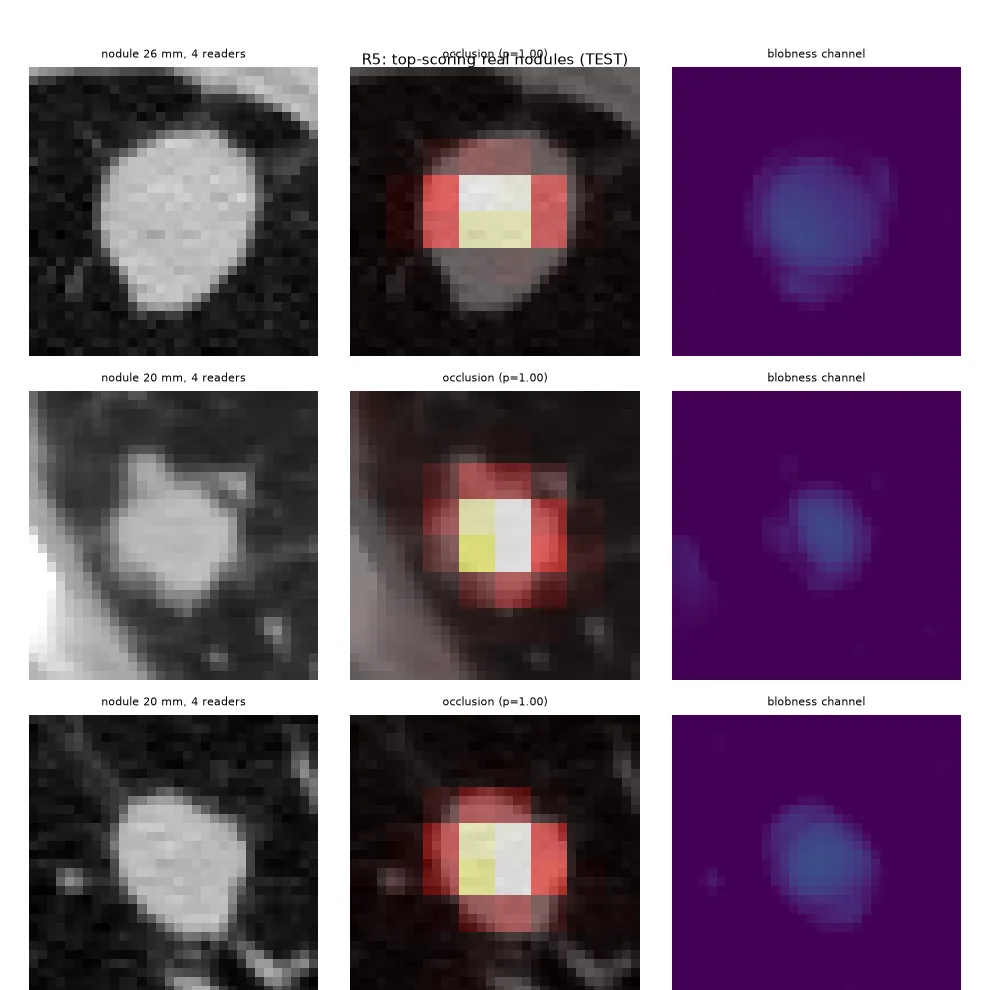
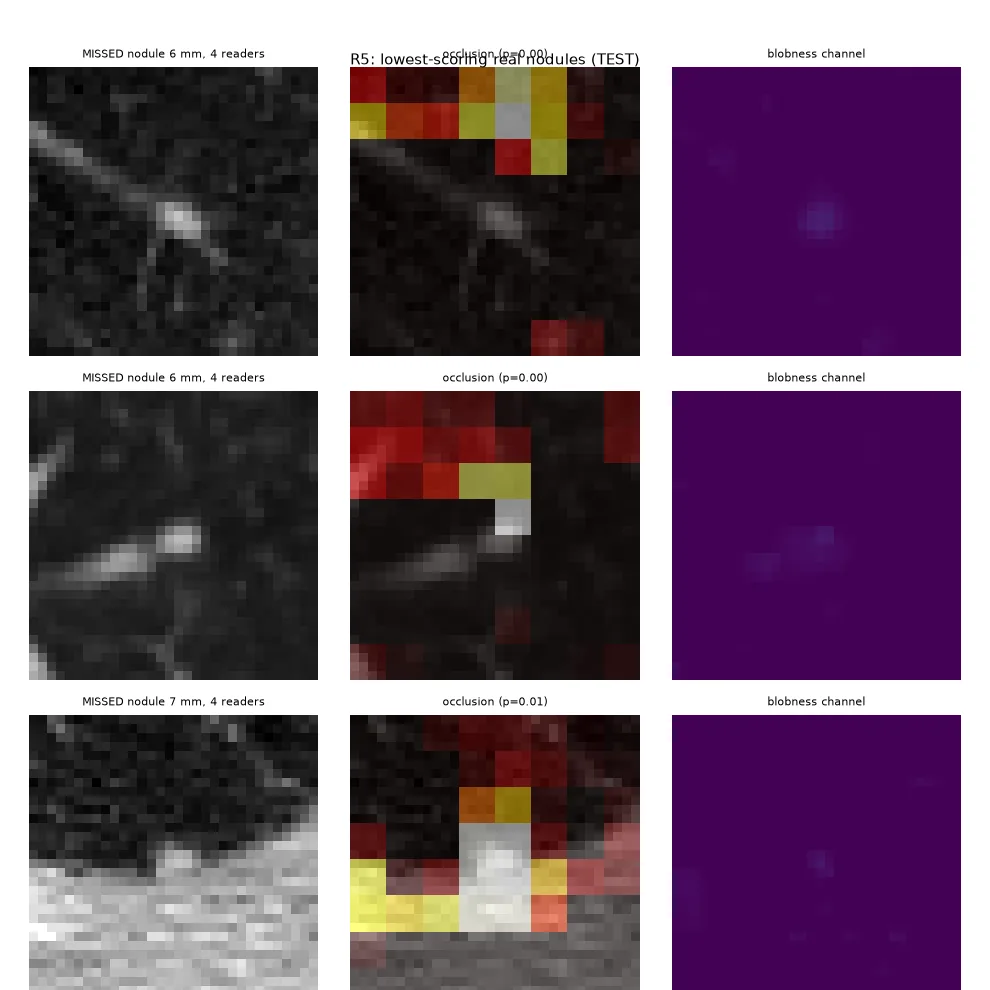
Figures exported from the project repository. CT images: LIDC-IDRI, The Cancer Imaging Archive, CC BY 3.0.
Where it fails
Known failure modes
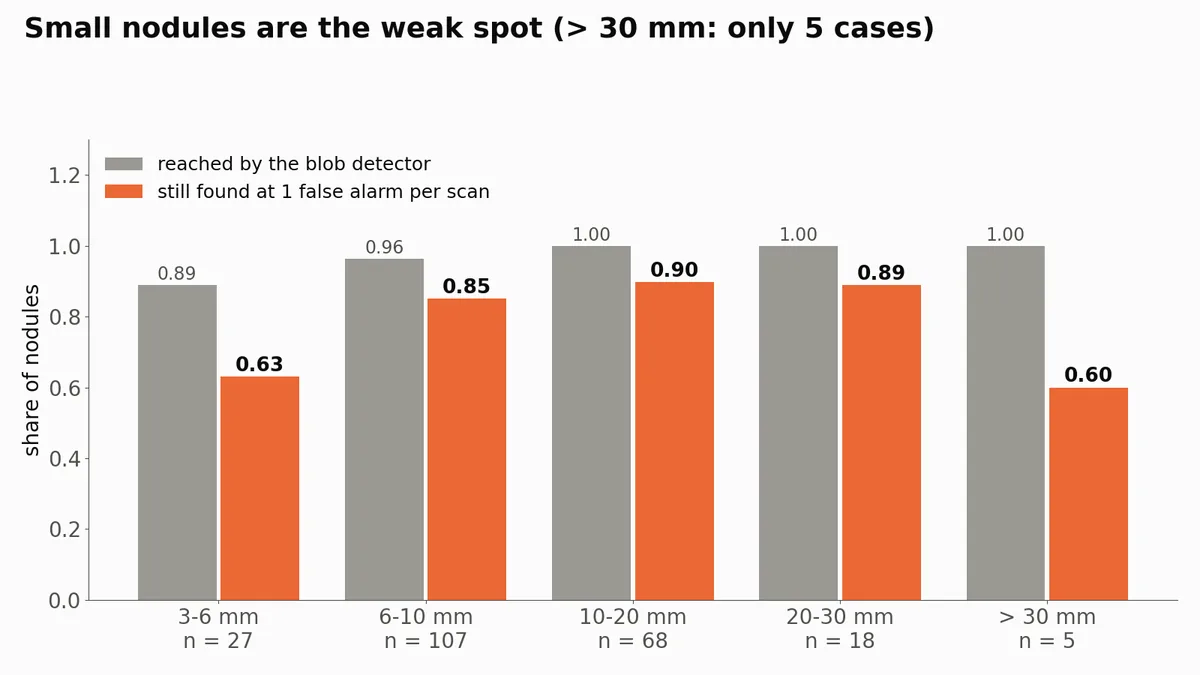
- Small nodules (3–6 mm): 63% found at one false alarm per scan.
- 7 of 225 test nodules are never proposed by the blob detector, so no later stage can find them.
- One dataset only, no external hospital; the test set is small (CI width about ±0.05 CPM).
Reproduce
pip install -r requirements.txt
gh release download v1.0 -p "lungdet-v1.0-hush-r5-weights.zip" && unzip lungdet-v1.0-hush-r5-weights.zip -d models
python predict.py /path/to/dicom_folder --fp-per-scan 1 --out out/